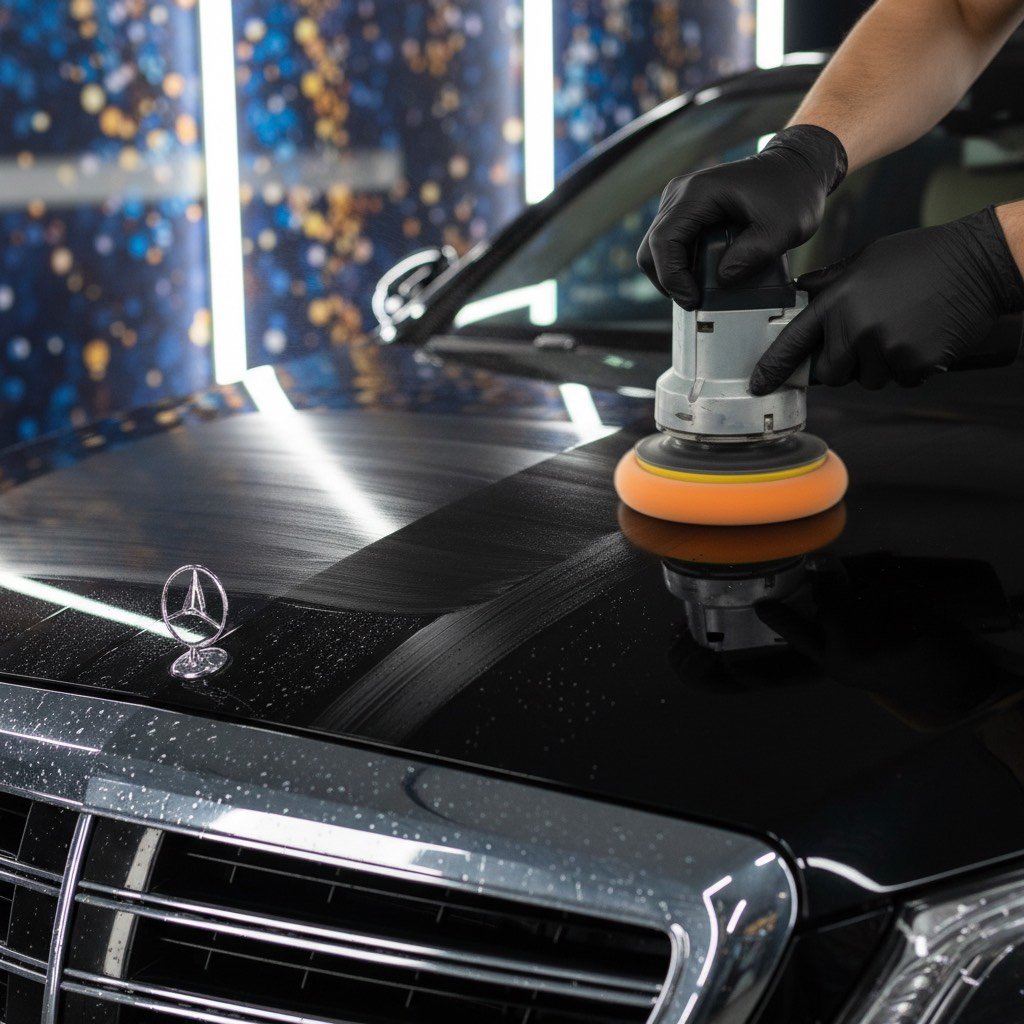
What an Automatic Car Wash Is Actually Doing to Your Paint
The tunnel car wash experience is convenient, and many drivers use them weekly without a second thought. What most don't realize is that automatic car washes. Particularly brush-style tunnels. Are one of the primary causes of swirl marks and micro-scratches on modern automotive clear coat.
Here's why: the brushes and cloth strips in an automatic wash accumulate grit from every vehicle that passes through before yours. That grit becomes an abrasive that drags across your paint at high speed. Even "soft cloth" systems leave marks that aren't visible in overcast light but become obvious under direct sunlight or LED lighting. Over 18-24 months of regular automatic wash use, this accumulation is often severe enough to require a paint correction to address. A service that runs $299 to $799 depending on vehicle size.
Touchless Washes: A Better Option, But Still Limited
Touchless washes avoid the brush problem, but compensate with stronger chemical concentrations to achieve cleaning without mechanical contact. Those chemicals strip wax and paint sealant on contact, meaning your paint protection is removed every single time you run through one. You're not just washing your car. You're systematically stripping the protection that keeps UV, contaminants, and oxidation at bay.
What a Hand Wash Actually Accomplishes
A proper hand wash using the two-bucket method. One bucket of clean soapy water, one rinse bucket. With a clean microfiber wash mitt eliminates the cross-contamination problem entirely. The wash surface never redeposits grit from one panel to another. Combined with a pH-neutral car shampoo that preserves existing protection, a proper hand wash maintains your paint's condition rather than degrading it.
This is the floor of what professional detailing starts with. But it's only the beginning.
What a Professional Detail Includes That a Car Wash Never Will
A professional mobile detail is a fundamentally different service than a car wash. Comparing them is like comparing a hotel room cleaning to a deep renovation. A car wash removes surface dirt. A professional detail addresses the layers beneath that surface: embedded contamination, oxidation, paint protection, interior air quality, and glass clarity. Specifically, our Essential package includes:
- Two-stage exterior hand wash and decontamination rinse
- Clay bar treatment to remove embedded metallic and environmental contamination
- Tire and wheel cleaning with pH-safe wheel cleaner
- Paint sealant or wax application for 3-4 months of UV protection
- Interior vacuum, wipe-down of all surfaces, and window cleaning
- Door jamb and glass edge cleaning. Areas a car wash never touches
See the difference in person
Our Essential package at $159 for sedans includes everything a car wash leaves behind. We come to you. No driving, no waiting in line. Book takes under two minutes. Aura mobile detailing brings the full detail to the driveway.
Book a DetailThe Annual Cost Comparison
Let's do the actual math for a Sacramento driver using a weekly automatic wash versus quarterly professional detailing:
- Weekly car wash ($15/visit × 52 weeks): $780 per year. Plus the cost of paint correction every 2-3 years ($299 to $799)
- Quarterly professional detail ($159 × 4): $636 per year. With paint protection maintained, no correction needed
The car wash is not actually cheaper when you account for the damage it accumulates. And that calculation doesn't include the resale value difference. A vehicle maintained with professional detailing typically commands 10-15% more at trade-in or private sale.
Paint Protection Longevity: The Decisive Factor
The most important distinction between the two approaches is what happens to your paint's protective layer. A quality paint sealant applied by a professional detailer lasts 3-4 months. Ceramic coating. The premium tier of paint protection. Lasts 2-5 years depending on formulation and application quality.
Every time you run through an automatic wash, you're eroding that protection. After four automatic washes, a freshly applied wax is largely gone. After a touchless wash with strong detergents, even a paint sealant can be compromised significantly. The result is that your paint surface is exposed. Directly to Sacramento UV, agricultural particulate, bird acid deposits, and tree sap. Without the buffer that professional protection provides.
If you want to extend the life of any paint protection investment, avoiding automatic car washes is the single most impactful change you can make between professional services.
When a Car Wash Makes Sense
We're not suggesting never use a car wash. For a quick rinse between professional details. Particularly before a detail appointment when you want to remove loose surface debris. A touchless rinse-only wash is fine. What causes damage is using an automatic wash as a substitute for professional detailing, especially on vehicles with darker paint colors where swirl marks become most visible.
The honest answer: use a professional detail as your primary maintenance service, and limit car wash visits to a touchless rinse if needed between appointments. Your paint will look dramatically better three years from now.